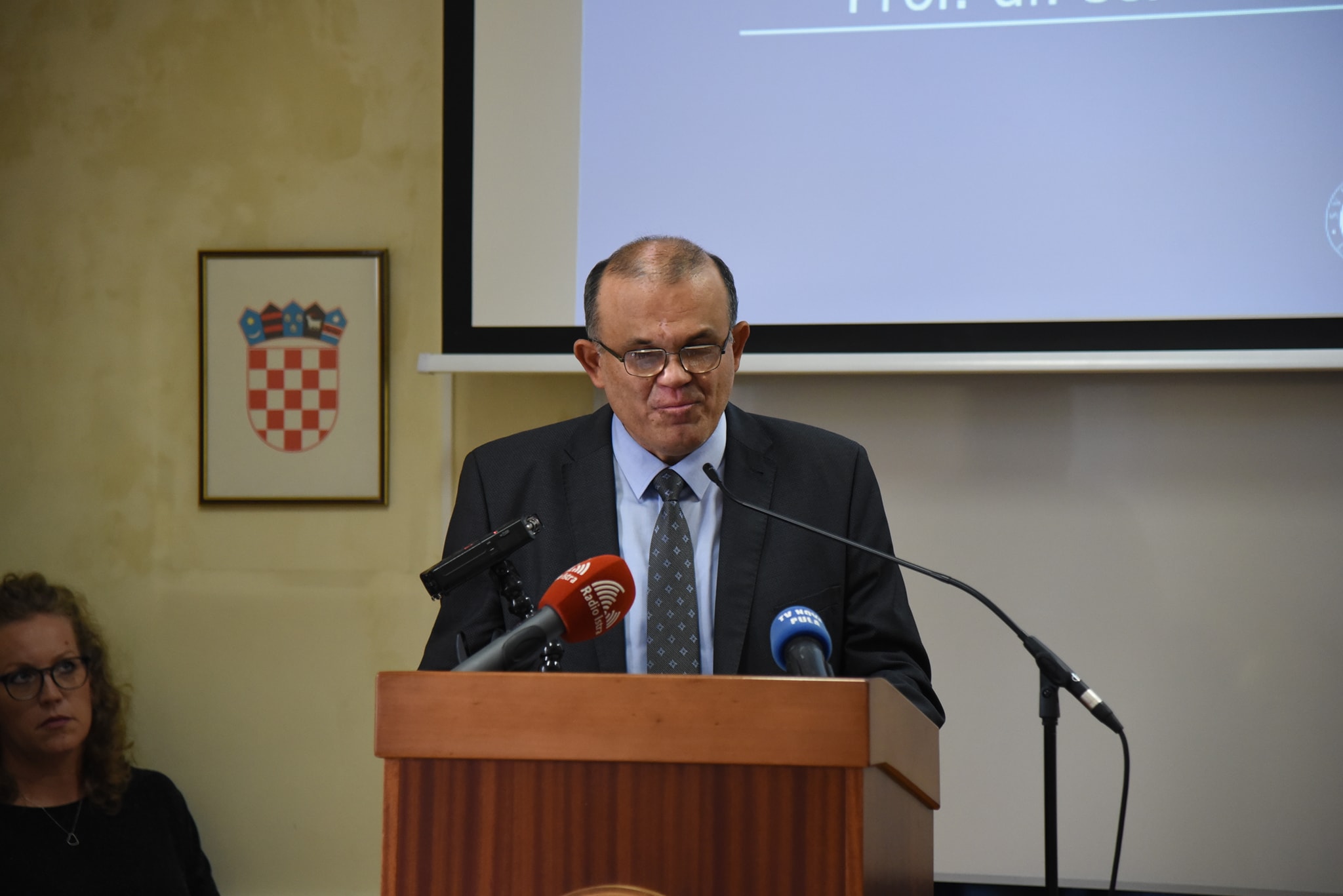
The Academy was held on Thursday, September 15, 2022 in the Pazin College in the morning. The Academy, which was held prominently in the Auli minor of the Pazin College, where many crucial events closely related to this legal act were postponed. The Academy was attended by the Archbishop and Metropolitan of Split-Makarska and the Apostolic Director of Poreč and Pula dioceses, Mons. Dražen Kutleša, Archbishop of Đakovo-Osijek and Metropolitan, Mons. Đuro Hranić, Archbishop of Đakovo-Osijek in Peace, Mons. Marin Srakić, Bishop of Poreč-Pula in Peace, Mons. Ivan Milovan, Prefect of the Istrian County, Boris Miletić, Head of the County Department for Culture and Heritage Vladimir Torbica, Mayor of the City of Pazin, Suzana Jašić, Director of the State Archives in Pazin, Mirela Mrak Kliman, Deputy Head of the Istrian Police Administration, Božo Kirin, Head of the Department of State History and Law of the Faculty of Law of the University of Rijeka, prof. dr. sc. Željko Bartulović, prof. dr. sc. Budislav Vukas M., Full Professor at the Faculty of Law, University of Rijeka, Assoc. prof. dr. sc. Ivan Milotić, Professor at the Faculty of Law, University of Zagreb, Master of Canon Law, Vlč. Ilija Jakovljević and Director of the Pazin College – Classical Gymnasium, Vlč. Maximilian Ferlin. In addition to these gatherings, numerous priests, historians, persons engaged in related professions, employees of DAPA and museums, employees of the Pazin city administration, numerous interested citizens and radio and television teams, as well as journalists of newspapers and portals were present. The Academy was organized by the Poreč and Pula dioceses and co-organized by the Istrian County, the City of Pazin and the State Archives in Pazin.
In her welcome speeches, Mirela Mrak Kliman, Director of the State Archives in Pazin, emphasized that this academy points to the importance of signing Treaty of Peace with Italy 1947 and the Decision on Acceptance of the Agreement contained in the Memorandum of Understanding between the Governments of Yugoslavia, the United States, France and the United Kingdom on the Free Territory of Trieste, but also points to the importance of archival material and archives through which we obtain such and other data that marked and significantly determined our further or closer history.